
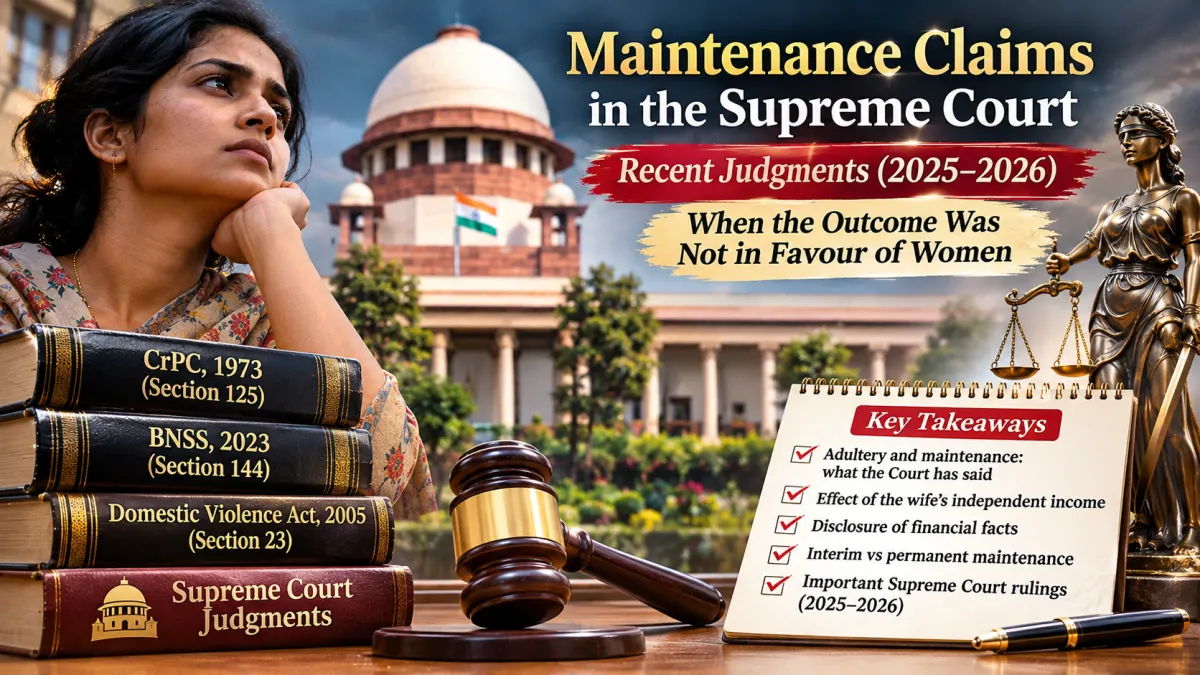
The law of maintenance protects need. It does not protect misuse.
Most of what we read about maintenance says one thing: the law is on the wife's side. That is true, and it remains true. But in the last two years the Hon'ble Supreme Court has also passed a quieter line of rulings in which the wife lost. A settled claim could not be revived through a Domestic Violence case. A plea of adultery has to be heard at the very start. A wife who walked out of a settlement claiming ₹120 crore of jewellery was told her allegations were "trivial disagreements exaggerated". A demand for ₹12 crore on top of a Mumbai flat was refused because she had "the educational qualifications as also the potential" to maintain herself. These cases are rarely discussed. They should be, because every one of them carries a lesson, for the woman who claims maintenance and for the advocate who advises her.
In 30 seconds
- A settlement is final. A wife who gives up maintenance in a settlement cannot bring the same claim back through a Domestic Violence case. The Court calls that an abuse of process, and says the party who backs out "must be encumbered with heavy costs".
- Adultery is a statutory bar. If the husband shows it clearly at the start, or it is admitted, interim maintenance can be stopped.
- Maintenance is support, not a share of his wealth. The Court has "serious reservations" about alimony claimed "as an equalisation of wealth".
- An educated, earning wife is expected to support herself where she can. Education alone does not end her claim, but inflated demands are refused.
- Exaggerated cases collapse. DV and 498A complaints filed as pressure are being quashed as "trivial disagreements exaggerated" and "ordinary marital squabbles".
- A lump sum closes the door. Once one-time alimony is fixed, no further claim survives under Section 125 CrPC (now Section 144 BNSS).
- Even a wife who loses can still be maintained. In 2026 the Court upheld a divorce on findings of the wife's cruelty, and still ordered ₹10,000 a month for her.
Why should these cases matter to a woman seeking maintenance?
In plain words: knowing where claims fail is the best way to make sure yours does not.
Section 144 BNSS (old Section 125 CrPC) is welfare law. The Supreme Court has said again and again that it must be read liberally, "for the welfare and benefit of the wife and daughter" (Shantha @ Ushadevi v. B.G. Shivananjappa, (2005) 4 SCC 468, para 8). But the same section contains its own limits. Section 144(4) says no wife shall be entitled to maintenance "if she is living in adultery or if, without any sufficient reason, she refuses to live with her husband or if they are living separately by mutual consent." Section 144(5) says that on proof of any of these, "the Judicial Magistrate shall cancel the order." The rulings below show the Court applying those limits, and adding a few of its own: finality of settlements, no use of law as a weapon, and maintenance as support rather than a share of wealth.
Can a wife claim maintenance again after giving it up in a settlement?
In plain words: no. If you settle and give up maintenance, you cannot bring the same claim back later through a Domestic Violence case. The Court will quash it.
Reji Baby v. Subi Mary & Ors., 2026 INSC 918 (24 August 2026), Sandeep Mehta and Manmohan, JJ. (judgment by Manmohan, J.). In a settlement the wife agreed she "will not claim any maintenance allowance", and in an affidavit before the Family Court she said, "I have relinquished my claim for maintenance". The couple then divorced by joint petition under Section 10A of the Divorce Act, 1869. She later filed a DV complaint for money. The Supreme Court quashed it: "the proceedings under the DV Act constitute an abuse of process. Once the respondent No.1-wife had voluntarily relinquished all monetary claims, including maintenance, revival of such claims through subsequent proceedings cannot be permitted" (para 8). Her plea of duress failed because she had never challenged the settlement or the decree: "Mere averments of coercion, absent any legal challenge, cannot suffice" (para 12). The parties, "being well educated and cognizant of their rights, must be deemed to have consciously and voluntarily executed" the settlement (para 12). One point went the other way: the adult daughter was not a party, so her right to claim was expressly kept alive (para 14).
Dhananjay Rathi v. Ruchika Rathi, 2026 INSC 360 (13 April 2026), Rajesh Bindal and Vijay Bishnoi, JJ. (judgment by Vijay Bishnoi, J.). After 23 years of marriage, the parties signed a mediated settlement. The husband paid ₹75 lakh, ₹14 lakh for a car, and returned the listed jewellery. The wife then refused to sign the second motion, saying she had been promised jewellery worth ₹120 crore and gold biscuits worth ₹50 crore that were left out of the written settlement, and filed a DV case against the husband and his mother. The Court quashed the DV case and granted divorce under Article 142. It held that once parties settle their disputes in full, "it is not open for the party to step back from the terms and conditions so arrived between them" (para 29), and that "the resiling party must be encumbered with heavy costs" (para 30). It could not see why she, "being a mature and educated woman assisted by her advocate, did not press for the inclusion of these conditions" (para 34). Her other allegations were "trivial disagreements exaggerated, solely to justify the institution of the complaint under the DV Act" (para 39), and the DV case appeared "premeditated" (para 40). A DV complaint that only names family members without specific allegations "shall be nipped in the bud" (para 37).
For the professional reader. A settlement recorded before a court, acted upon by both sides, binds the parties. A later DV application that seeks only the waived claims, with no fresh cause of action after the decree, is open to quashing. The remedy for a settlement signed under pressure is to challenge the settlement or the decree itself, not to file a fresh case around it.
Can a wife living in adultery be denied interim maintenance?
In plain words: yes, if the husband shows it clearly at the start. The court must decide that objection early; it cannot simply leave it to the end of the case.
Himanshu Chordia v. State of Rajasthan & Anr., 2026 LiveLaw (SC) 748, SLP (Crl.) No. 3171 of 2025 (31 July 2026), Sanjay Karol and Vipul M. Pancholi, JJ. The husband applied under Section 125(4) CrPC, saying the wife lived in adultery. The trial court and the High Court refused to examine it until final hearing. The Supreme Court allowed his appeal. It held: "Adultery, if proved, takes away maintenance from the wife" (para 16), and that if the husband "is, at the first instance, able to establish the charge through evidence ex facie, then only, there can be said to be a bar to interim maintenance" (para 18). If the evidence shows adultery "on the face of it" or it is "admitted", "the interim maintenance would be stopped and the application for maintenance would be dismissed" (para 13.1). The courts below "clearly fell into error" in deferring it (para 19). The matter went back to the trial court. Noting that about 92 videos and 237 photographs had been filed, apparently through private investigators, the Court sent copies to the Ministry of Law and Justice and the Law Commission to consider regulating private detectives (paras 21–24). Read the judgment
What it does not say. There was no finding that this wife committed adultery. The Court said "the pendency of a 125(4) application would not per se bar the applicant from receiving interim maintenance" (para 11), and the party alleging adultery "must present clear and cogent evidence" (para 14). A bare allegation is not enough.
Can an educated wife demand crores as alimony?
In plain words: maintenance is meant to support you, not to make you equal to your husband's wealth. And if you are qualified and able to earn, the Court will take that into account.
Anurag Vijaykumar Goel v. State of Maharashtra & Anr., 2025 INSC 926, Criminal Appeal No. 5277 of 2024 (5 August 2025), bench of CJI B.R. Gavai (judgment by K. Vinod Chandran, J.; non-reportable). Both parties had been divorced once before; this marriage lasted one year and nine months. The wife had agreed to a settlement giving her a Mumbai flat, then backed out and claimed ₹12 crore as permanent alimony on top of the flat. The Court dissolved the marriage under Article 142, quashed her Section 498A case, and gave her the flat and two parking spaces, nothing more. It held that "the alimony received by the respondent on the dissolution of her first marriage is not a relevant consideration" (para 17). But it also reckoned that she "was gainfully employed and has the educational qualifications as also the potential, by way of her past experience in the field of information technology, to maintain herself." It found that she had "turned turtle to resile from the settlement", and saw in her criminal complaint "nothing more than ordinary marital squabbles, skirmishes and bickerings blown out of proportion". (The widely reported remark "You are so educated. You should earn for yourself" was made by the Chief Justice at the hearing in July 2025; it is not in the written judgment.)
Rinku Baheti v. Sandesh Sharda, 2024 INSC 1014; (2025) 3 SCC 686 (19 December 2024), B.V. Nagarathna and Pankaj Mithal, JJ. (judgment by Nagarathna, J.). The wife said the husband was worth ₹5,000 crore and had paid his first wife at least ₹500 crore; the husband offered ₹20–40 lakh. The Court fixed ₹12 crore, but recorded: "We have serious reservations with the tendency of parties seeking maintenance or alimony as an equalisation of wealth with the other party" (para 14.5), and asked whether a wife would seek equalisation if the husband had been "rendered a pauper". It added a warning now quoted in matrimonial courts across the country: "The women need to be careful about the fact that these strict provisions of law in their hands are beneficial legislations for their welfare and not means to chastise, threaten, domineer or extort from their husbands" (para 10).
For the professional reader. These remarks do not overrule Rajnesh v. Neha, (2021) 2 SCC 324. The quantum is still fixed on the Rajnesh factors: status, reasonable needs, income and property of both sides, and the standard of living during the marriage. What the Court rejects is a claim built on the husband's wealth rather than the wife's needs. Rajnesh itself put it even-handedly: "While there is a tendency on the part of the wife to exaggerate her needs, there is a corresponding tendency by the husband to conceal his actual income."
What happens to exaggerated criminal and DV cases in a maintenance dispute?
In plain words: a case filed only to put pressure on the husband can collapse, and it weakens everything else you ask for.
Two of the rulings above show the Court looking hard at the complaints themselves. In Dhananjay Rathi the DV case was "premeditated" and its allegations "trivial disagreements exaggerated". In Anurag Goel the Section 498A complaint showed "nothing more than ordinary marital squabbles, skirmishes and bickerings blown out of proportion". Both were quashed.
Shivangi Bansal v. Sahib Bansal, 2025 INSC 883 (22 July 2025), B.R. Gavai CJ and Augustine George Masih J. (judgment by Masih, J.; non-reportable). This case is often reported as a defeat for the wife, but it is better understood as an order on agreed terms: the Court acted on the parties' "conditions/settlement" and their undertakings. The wife, an IPS officer, had filed several cases, and "the Husband remained in jail for a period of 109 days and his father for 103 days" (para 20). The wife "voluntarily agreed to forgo and waive her claim to any alimony or maintenance" (para 9). Because she agreed to bear the daughter's expenses, the High Court's order of ₹1,50,000 a month for the child's maintenance was quashed (para 10). She and her parents were directed to publish an unconditional apology in the national editions of an English and a Hindi newspaper, which "shall not be construed as an admission of liability" (para 20), and she was directed never to use her position as an IPS officer against the husband's family (para 19).
Does a cruelty finding against the wife end her maintenance?
In plain words: not necessarily. You can lose the divorce case and still be maintained.
Mamta Devi v. Sanjay Kumar, 2026 INSC 346 (10 April 2026), Vikram Nath and Sandeep Mehta, JJ. The courts below had found that "the conduct attributed to the appellant constituted cruelty towards the respondent" and that "she had withdrawn from his society without reasonable cause". The Supreme Court refused to disturb the divorce decree, finding "the matrimonial bond has broken down beyond repair". Yet it still directed the husband to pay her ₹10,000 a month from the date of its order, in place of the Family Court's lump sum of ₹6,00,000, "in the interest of complete justice". Read the judgment
Does one-time alimony end all future maintenance claims?
In plain words: yes. A lump sum is final. Think carefully before you accept one.
Salil Dhawan v. Priyanshi Ghai, 2026 INSC 577 (27 May 2026), Vikram Nath and Sandeep Mehta, JJ. The husband is an Army officer; the wife is a qualified dentist. Under a settlement she received ₹20 lakh of an agreed ₹32 lakh, then did not sign the second motion for mutual divorce. Before the Supreme Court she opposed a divorce under Article 142 and wanted to file her own case alleging adultery. The Court granted the divorce anyway, after eight years of separation, and fixed ₹50 lakh, more than the husband's offer. But it made the sum final: "This amount shall constitute a one-time, full and final settlement of all claims, past and future, arising from this marriage. It is made clear that upon payment of this amount, no further claims for maintenance shall survive, whether under Section 125 CrPC or the Army Act and Rules" (para 11). All pending cases, including her DV and Section 125 cases, were closed.
Do these rulings mean the Supreme Court has turned against wives?
In plain words: no. None of these cases refuses maintenance to a woman in genuine need. Every loss came from something she did: settling and coming back, a statutory bar, an inflated demand, or a case filed as pressure.
In the same months, the Court was firm the other way when the husband played games. In April 2026, faced with a husband who resigned from company directorships and then pleaded that he could not pay, it held that his "claim of financial incapacity is nothing but a subterfuge to evade his legal and moral obligations" (XXX v. YYY, 2026 LiveLaw (SC) 347, para 59; Read the judgment). The same judgment said that "even if the appellant-wife is highly educated and professionally qualified, that by itself cannot be a reason to absolve the respondent-husband" of his responsibility (para 58). And Rajnesh v. Neha still governs every case: "maintenance in all cases will be awarded from the date of filing the application for maintenance" (para 102), and "If the husband does not disclose the exact amount of his income, an adverse inference may be drawn by the Court" (para 66).
The law has not changed sides. It has drawn its boundary more clearly.
What should a woman learn from these cases?
- Read a settlement twice before you sign it. If it waives maintenance, that waiver will be enforced. If you signed under pressure, challenge the settlement itself, quickly.
- Think before accepting a lump sum. One-time alimony ends future claims. Weigh it against monthly maintenance for the years ahead.
- Claim what you need, and prove it. Your needs, your children's needs and the standard of living you had: these win. A figure based only on his wealth does not.
- If you can work, show the court what you have tried. Education alone does not end your claim, but the court will ask.
- File only what is true. An exaggerated DV or criminal case can be quashed as "trivial disagreements exaggerated", and it weakens everything else you ask the court for.
- Be ready for an adultery plea at the start. The court may now hear it before interim maintenance; keep your answer and your evidence ready.
What should the advocate take from them?
- Defending a husband: where there is clear material of adultery, move under Section 144(4) BNSS early and ask for it to be decided at the threshold (Himanshu Chordia). Electronic evidence will need a Section 65B certificate (now under the Bharatiya Sakshya Adhiniyam). Where a settlement was acted upon, a later DV case seeking the same claims is open to quashing (Reji Baby; Dhananjay Rathi).
- Acting for a wife: plead need, not parity of wealth, and build the claim on the Rajnesh factors. Where she is qualified, place her job search on record. Never let a criminal case be used as leverage in a maintenance dispute; it now carries real risk.
- On settlements: record clearly whether a child's claim is included. Reji Baby kept an adult daughter's independent right alive because she was not a party.
In short
The law of maintenance is a shield for the woman who needs it. The Supreme Court has now made it equally clear that it will not let that shield be used as a sword. Ask for what you need, prove it honestly, and the law is still in your favour.
This article provides general legal information, not legal advice for any particular case.
Related reading:
- Maintenance from Husband: Why It Takes So Long, and What to Do If He Doesn't Pay
- Maintenance & Alimony

Founding Advocate of Chanda Associates, Kolkata; former Judicial Officer, West Bengal Judicial Service. Writer and researcher. jewelchanda.com · About the advocates
This article is general legal information, not legal advice for any particular case. The law and court practice change; check the current position before acting.