
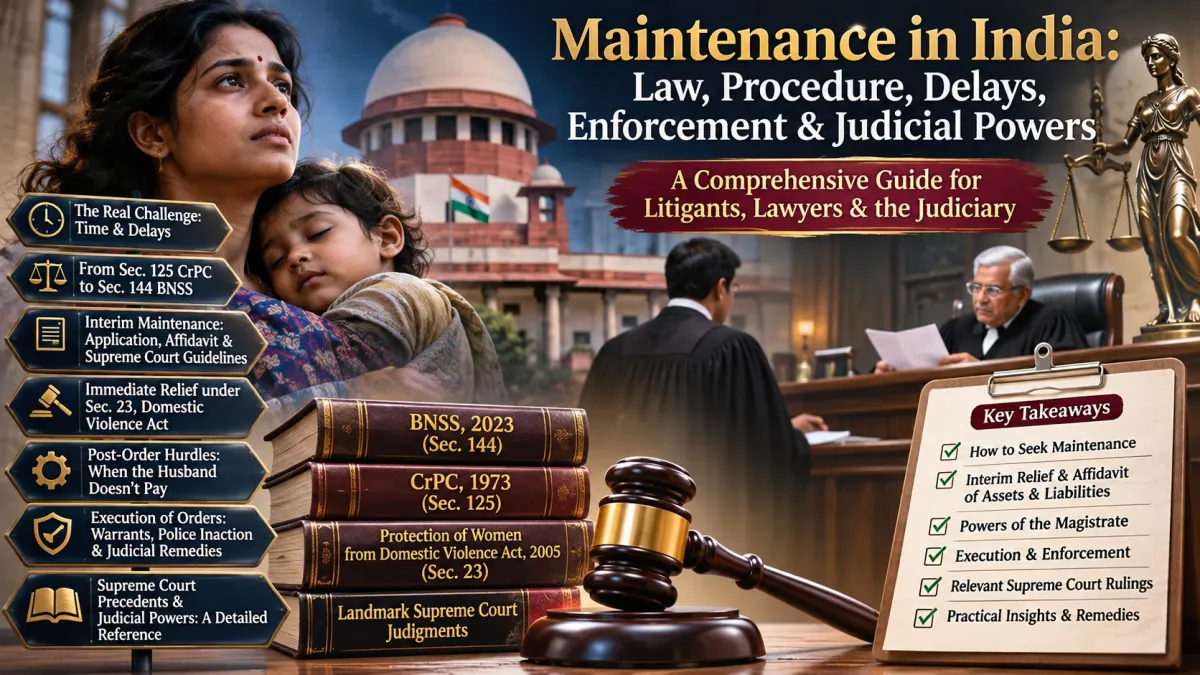
The law is already in your favour. What it asks of you is patience, and time.
A woman who files for maintenance usually asks two questions. How long will it take? And what if he still does not pay? Let us be honest with both. The law on maintenance is clear and kind to the wife. The real hurdle is time: the months, often years, before interim maintenance is granted, and then the second struggle to recover the money after the order. This page explains both stages in plain words, and sets out, with the statute and the judgments, every power a Ld. Magistrate holds to make the order real.
In 30 seconds
- The biggest hurdle is time, not the law.
- Maintenance runs from the date you filed the application, so every month of delay becomes money he owes you.
- If you cannot afford the case, the court can make him pay your case expenses, and every woman is entitled to free legal aid.
- Under the Domestic Violence Act, the Magistrate can grant interim money on your affidavit alone, on the first day.
- Unpaid maintenance is not lost after one year. One timely execution application covers the months that follow.
- Jail does not wipe out the debt. Only payment does.
- The Magistrate does not depend on the police alone. His goods can be seized and sold, the Collector can recover the money like land revenue, it can be cut from his salary, he can be declared an absconder, and the order can be executed like a civil decree.
How long does it take to get maintenance from husband in India?
On paper, about two months. The law says an interim maintenance application should be decided, as far as possible, within sixty days of notice. In practice, in our experience at the trial courts, it often takes seven months to two years, sometimes more. So the first hurdle is time, not the law. The second comes after the order: actually getting the money from a husband who does not pay.
Why does interim maintenance take so long?
In plain words: a fair hearing has stages, and at every stage the other side can ask for time. The court usually gives it.
This is how a case normally moves:
- The application is filed and notice goes to the husband.
- An advocate appears for him and says, "I will file a written objection."
- The court directs him to file the affidavit of assets and liabilities along with it.
- On the next date he says, "It is not ready today. Please give me one more date." The court gives it.
Why does the court give time? Because a court cannot be rigid and one-sided. The system our forefathers built, and generations of judges after them followed, rests on one idea: give every person a fair chance to contest. Justice must be impartial, and it must look impartial too. In Lord Hewart's famous words, justice "should not only be done, but should manifestly and undoubtedly be seen to be done" (R v. Sussex Justices, 1924). To be fair, the court has to be lenient, give the other side time, and give him a chance to file his affidavit.
The real cost lies in the gaps between dates. In our experience at the trial courts:
- In a busy court, the next date may be two or three months away.
- Four or five adjournments of the interim hearing can easily use up a year or eighteen months.
- Not every date produces work. The Presiding Officer may be on leave. The Bar may resolve not to work after a member's death. There may be a strike or a local disturbance.
- When a Magistrate is transferred, the court can lie vacant for weeks or months, and only dates are given.
The Hon'ble Supreme Court has seen this too. In April 2026 it recorded a wife's execution proceedings lying undecided for over two years, with no presiding officer posted to the court (XXX v. YYY, 2026 LiveLaw (SC) 347, para 23). On abstention from work, it held in 2023 that "no member of the Bar can go on strike and/or abstain himself from court working" (District Bar Association, Dehradun v. Ishwar Shandilya, 20 April 2023; Read the order).
Where the opposite party is strong, his advocate may file interrogatories, which the law allows, and then one petition after another, all to push the interim hearing as far away as possible.
Will I get maintenance for the months the case was pending?
In plain words: yes. Delay does not help the husband. It usually hurts him.
In Rajnesh v. Neha, (2021) 2 SCC 324, the Supreme Court directed "that maintenance be awarded from the date on which the application was made before the concerned Court". Citing its earlier ruling in Shail Kumari Devi, it said the entitlement "should not be left to the uncertain date of disposal of the case", and in its final directions it made the rule universal: "maintenance in all cases will be awarded from the date of filing the application for maintenance" (para 102). So every month of delay becomes arrears, payable in one heavy amount. From a good advocate's point of view, delaying tactics bring the client no real benefit.
What if I cannot afford the cost of the maintenance case?
In plain words: enforcing the law costs money: court fees, certified copies, travel, the advocate, lost working days. The woman who has come to court because she has no money is the one least able to fund a long case. The law knows this. You can ask the court to make the husband pay your case expenses, and every woman is entitled to free legal aid, whatever her income.
For the professional reader:
- Expenses of the case. Section 144(1) BNSS provides for "the monthly allowance for the interim maintenance and expenses of proceeding". Section 24 of the Hindu Marriage Act and Section 36 of the Special Marriage Act are to the same effect. Rajnesh counts "reasonable costs of litigation for a non-working wife" among the matters the court must weigh. Pray for litigation expenses in the same application as interim maintenance.
- Free legal aid. Under Section 12 of the Legal Services Authorities Act, 1987, "Every person who has to file or defend a case shall be entitled to legal services under this Act if that person is—… (c) a woman or a child". There is no income limit for women. Apply to the District Legal Services Authority at the district court.
Can I get maintenance immediately from my husband?
In plain words: yes and no at the same time. The law allows it on the very first day. Whether you get it depends on the Magistrate.
The Protection of Women from Domestic Violence Act, 2005 gives the faster route. Section 23(2) allows the Magistrate to "grant an ex parte order on the basis of the affidavit" of the aggrieved woman, including monetary relief under Section 20. The only condition is that the application prima facie shows domestic violence or its likelihood. So money can be ordered on the first day, on her affidavit alone, before the husband even appears. It works like an ex parte injunction. The affidavit is filed in Form III under Rule 7 of the DV Rules, 2006. The official rights notice in Form IV tells every woman: "Any of the above relief can be granted on an interim basis, as soon as you make a complaint of domestic violence and present your application for any of the relief before the Court."
The idea is old. In 1985, when Section 125 CrPC still said nothing about interim maintenance, the Supreme Court read the power into it: the provision "should be interpreted as conferring power by necessary implication on the magistrate", and "Such an order may also be made in an appropriate case ex parte pending service of notice". A contrary view, the Court said, "is likely to result in grave hardship to the applicant, who may have no means to subsist." (Savitri v. Govind Singh Rawat, (1985) 4 SCC 337; Read the judgment). Parliament later wrote interim maintenance into the Code. It is now the second proviso to Section 144(1) BNSS.
In practice, many Judicial Magistrates do not use the Section 23(2) power. They prefer to hear both sides first. That is judicial discretion, and it is not for us to call it right or wrong; an order a party does not like can be challenged before the higher court. Speaking only academically: the restraint does not come from the law. If a woman says, "I am starving, he does not maintain me," and the papers prima facie show that he earns, has a job, and that there is a child or a wife without support, nothing in the law stands in the way of immediate interim maintenance. A maintenance case is not, by default, an exaggerated or false claim. Very often it is the most urgent case on the board.
What if my husband hides his income?
In plain words: the court can presume the worst against a husband who hides his income.
Since Rajnesh, both parties must file an affidavit disclosing their assets and liabilities. The Court was even-handed about why: "While there is a tendency on the part of the wife to exaggerate her needs, there is a corresponding tendency by the husband to conceal his actual income." And it held: "If the husband does not disclose the exact amount of his income, an adverse inference may be drawn by the Court" (para 66).
In April 2026 the Supreme Court dealt firmly with a husband who resigned from company directorships and then pleaded that he could not pay. Speaking through Justice Sandeep Mehta, the Bench held:
"…claim of financial incapacity is nothing but a subterfuge to evade his legal and moral obligations." — XXX v. YYY, decided 7 April 2026, 2026 LiveLaw (SC) 347, para 59. Read the judgment
Useful evidence: income tax returns, salary slips, bank statements, property and company records, and proof of how he lives and spends. In a DV case there is one more tool: under Rule 10(1)(b) of the DV Rules, 2006, the Magistrate can direct the Protection Officer, "after making appropriate inquiry, file a report on the emoluments, assets, bank accounts or any other documents as may be directed by the Court".
What happens if my husband does not pay maintenance?
In plain words: you file an execution case, and the court uses its powers to recover the money.
Under Section 144(3) BNSS, the Magistrate may issue a warrant to recover the amount "in the manner provided for levying fines". If it still remains unpaid, the husband may be sent to prison for up to one month, or until he pays, if sooner. File promptly: a warrant can be sought only for amounts that fell due within the year before the application. The older money is not lost, as explained below.
The usual course is this. The Magistrate calls the husband. He does not come. A warrant is issued. And here the second struggle begins.
Can a husband be jailed for not paying maintenance?
In plain words: yes, but jail is a pressure tool, not a payment. Going to jail does not cancel what he owes.
Under Section 144(3) BNSS, the sentence can be up to one month, or until payment if made sooner. The Supreme Court held in Kuldip Kaur v. Surinder Singh, (1989) 1 SCC 405, reaffirmed in Poongodi v. Thangavel, (2013) 10 SCC 618: "Sentencing a person to jail is a 'mode of enforcement'. It is not a 'mode of satisfaction' of the liability." The arrears remain payable after his release.
What if the police do not execute the warrant?
This is the most common grievance in our district courts. A warrant goes to the police station and is not executed. The Magistrate directs the warrant officer to appear in person; he does not come. Then the Officer-in-Charge; he does not come. Then reminders go through the Superintendent of Police. Year after year the reminders go, and no reply comes. The wife receives nothing.
Whatever the reason a warrant stays unexecuted, the Magistrate is not powerless. In our respectful view, the law gives the Magistrate ample power to implement his own order, and several of those routes do not need an arrest at all. Where an arrest is needed, the Supreme Court has shown the way: in Poongodi it directed the trial court "to issue a warrant for the arrest of the respondent and ensure that the same is executed and the respondent taken into custody" (para 8). The Allahabad High Court has said as much in plain terms. In Mala Kumari (24 July 2026) it directed trial courts to recover unpaid maintenance "by attaching the property" of the defaulter and to resort to imprisonment only "if the attached property is insufficient" (para 23(v)). It directed that "the District Administration as well as the Police Authorities are directed to cooperate in the matter" (para 25), and warned that non-compliance by presiding officers "is liable to attract disciplinary, as well as contempt proceedings" (para 24).
What can a Magistrate do to enforce a maintenance order?
A note for the Bench and the Bar. The answer depends on which law the order was passed under.
A. Order under Section 144 BNSS (old Section 125 CrPC)
- The right order of steps. In plain words: first a warrant to recover the money; jail only for what still remains unpaid after that. Law: Section 144(3) BNSS lets the Magistrate "issue a warrant for levying the amount due in the manner provided for levying fines", and then sentence the defaulter "for the whole or any part of each month's allowance… remaining unpaid after the execution of the warrant".
- Seize and sell his goods. Law: Section 461(1)(a) BNSS allows "a warrant for the levy of the amount by attachment and sale of any movable property". Judgment: Rajnesh lists attachment of property among the modes of recovering maintenance (para 95).
- Send it to the Collector. In plain words: the revenue machinery that collects government dues can collect the maintenance, with no arrest needed. Law: Section 461(1)(b) BNSS allows "a warrant to the Collector of the district, authorising him to realise the amount as arrears of land revenue." Section 144(3) applies this to maintenance by directing recovery "in the manner provided for levying fines".
- Jail, with the debt intact. Law: up to one month under Section 144(3). Judgment: Kuldip Kaur and Poongodi, above: jail is "a 'mode of enforcement'", not "a 'mode of satisfaction'".
- Enforce wherever he lives. Law: under Section 147 BNSS the order "may be enforced by any Judicial Magistrate in any place where the person against whom it is made may be".
- Declare him an absconder. In plain words: if he hides to avoid the warrant, the court can publicly order him to appear, and his property can then be attached. Law: where the court has reason to believe that a person against whom it issued a warrant has absconded, Section 84 BNSS allows a proclamation requiring him to appear.
- Attach his salary. Judgment: in Bhushan Kumar Meen v. Mansi Meen, (2010) 15 SCC 372 (decided 28 April 2009), the Supreme Court reduced an interim award because of the husband's home-loan deductions, but kept the Magistrate's salary-attachment order in reserve: if he defaulted, "the Magistrate will be at liberty to re-impose the order of attachment." And Rajnesh directs that a maintenance order "may be enforced as a money decree of a civil court" under Sections 51, 55, 58 and 60 read with Order XXI CPC (para 103); Section 60 is the provision under which salary is attached. Read the judgment
B. Order under the Domestic Violence Act
- Every power in Part A. In plain words: a DV maintenance order can be enforced in exactly the same way as a Section 144 order. Law: Rule 6(5) of the Protection of Women from Domestic Violence Rules, 2006: "The applications under section 12 shall be dealt with and the orders enforced in the same manner laid down under section 125 of the Code of Criminal Procedure, 1973".
- Order his employer to pay her directly. In plain words: the court can tell his office to cut part of his salary and pay it straight to the wife, or deposit it in court. Law: Section 20(6) of the DV Act lets the Magistrate "direct the employer or a debtor of the respondent, to directly pay to the aggrieved person or to deposit with the court a portion of the wages or salaries or debt due". Judgment: in its final directions, Rajnesh names this route expressly: an order of maintenance "may be enforced Under Section 28A of the Hindu Marriage Act…; Section 20(6) of the D.V. Act; and Section 128 of Code of Criminal Procedure, as may be applicable" (para 103).
- Use the Protection Officer, not only the police. In plain words: the DV Act gives the court its own officer to help enforce its orders. Law: under Rule 10(1)(e), the Protection Officer, if directed in writing by the Magistrate, shall "assist the Court in enforcement of orders in the proceedings under the Act in the manner directed by the Magistrate, including orders under section 12, section 18, section 19, section 20, section 21 or section 23".
- Resistance to the order is a breach. Law: Rule 15(7) provides that "Any resistance to the enforcement of the orders of the Court under the Act by the respondent or any other person purportedly acting on his behalf shall be deemed to be a breach of protection order or an interim protection order covered under the Act", and Rule 15(8) says such a breach "shall be dealt with as a cognizable offence as provided under sections 31 and 32." Whether a particular non-payment amounts to "resistance" is for the court to decide on the facts.
- Divorce does not end the order. In plain words: a DV maintenance order passed during the marriage can still be executed after a divorce. Judgment: the Calcutta High Court held: "Decree of divorce does not deprive the wife from the relief granted in her favour under the provisions of the Act of 2005", and "Existence of domestic relationship is not needed to execute the order granted under Section 12 of the Act of 2005". A divorced wife who has not remarried and cannot maintain herself "is entitled to execute the same" (Sri Krishnendu Das Thakur v. State of West Bengal, C.R.R. 3566 of 2018, Justice Madhumati Mitra, 28 June 2019; Read the judgment).
- Immediate interim money. Law: Section 23(2), ex parte on affidavit, explained above.
C. Order or decree under the matrimonial laws (Family Court)
- Execute it like a money decree. Judgment: Rajnesh holds that a maintenance order or decree "may be enforced like a decree of a civil court", through attachment of property and civil detention under the Code of Civil Procedure, including attachment of salary under Section 60 and Order XXI (para 95).
- Strike off his defence. Judgment: available, but Rajnesh says it "ought to be passed in the last resort, if the Courts find default to be wilful and contumacious."
- Contempt. Judgment: Rajnesh records that "Contempt proceedings for wilful disobedience may be initiated before the appropriate Court."
Seen together, these powers show that an unpaid order is seldom a gap in the law. It is a question of which tool is used, and when.
Is there a time limit to claim unpaid maintenance arrears?
In plain words: you do not lose your money just because a year has passed, and you do not have to file a fresh case every month. File the first execution application on time, and the court can keep recovering the later months under it.
For the professional reader. The proviso to Section 144(3) BNSS says no warrant shall issue "unless application be made… within a period of one year from the date on which it became due." The Supreme Court has read this narrowly, in favour of the person entitled:
- One timely application is enough. In Shantha @ Ushadevi v. B.G. Shivananjappa, (2005) 4 SCC 468, the Court reminded that Section 125 "is a measure of social legislation and it has to be construed liberally for the welfare and benefit of the wife and daughter. It is unreasonable to insist on filing successive applications when the liability to pay the maintenance as per the order passed under Section 125(1) is a continuing liability." (para 8). There, an execution petition filed in time in 1993 was "kept alive", and a later application in 1998 to state the up-to-date arrears was held to be "only supplementary or incidental" to it (para 7).
- The arrears are not wiped out. In Poongodi v. Thangavel (27 September 2013), the Court held that the proviso only means the warrant procedure "would not be available to a claimant who had slept over his/her rights". It did not find "that the same creates a bar" on arrears, and said "the ordinary remedy to recover the amount of maintenance, namely, a civil action would still be available." Read the judgment
- A High Court has turned this into directions for trial courts. In Mala Kumari v. State of U.P. (Allahabad High Court, Justice Praveen Kumar Giri, 24 July 2026), following Shantha and Poongodi, the Court directed that "successive execution applications are not required to be filed for receiving monthly maintenance", and that the first proviso to Section 125(3) CrPC/Section 144(3) BNSS "does not create any bar or affect upon the entitlement of a claimants to recover arrears of maintenance beyond a period of one year" (para 23(i) and (ii)).
Why do so many women lose faith in the process?
Because the person who most needs the money is the one who has to wait, and often she is fighting several cases at once. In the April 2026 case, the Supreme Court found that the husband had multiplied proceedings at every stage, and said: "Most of these proceedings appear to be vindictive and vexatious" (para 53). It finally ended what it called a "decade-long dispute" with one order.
Three habits help:
- keep a month-by-month record of what is due and what is received;
- file execution promptly, and ask the court to keep it alive for future months;
- think about whether a one-time permanent settlement would end the need for repeated execution.
And let every side understand one thing. A maintenance case is a necessary case. A woman who says she cannot feed herself or her child deserves to be heard quickly.
In short
Getting maintenance from the court needs patience, and time given to it. It is like growing a plant: you nourish it, and at the right time it gives you its fruit. The system is slow. The hurdle is patience and time, not the law. The law is already in your favour.
This page provides general legal information, not legal advice for any particular case.
Related reading: